
What Your Procrastination Is Really Protecting
If performance confidence fractures under pressure, the first place it shows up is rarely a bold mistake or a public failure. It shows up in what you quietly postpone.
Most leaders frame procrastination as a productivity problem. Something to manage with better systems, tighter schedules, or stronger willpower. But after years of working with leaders, I've come to see it differently.
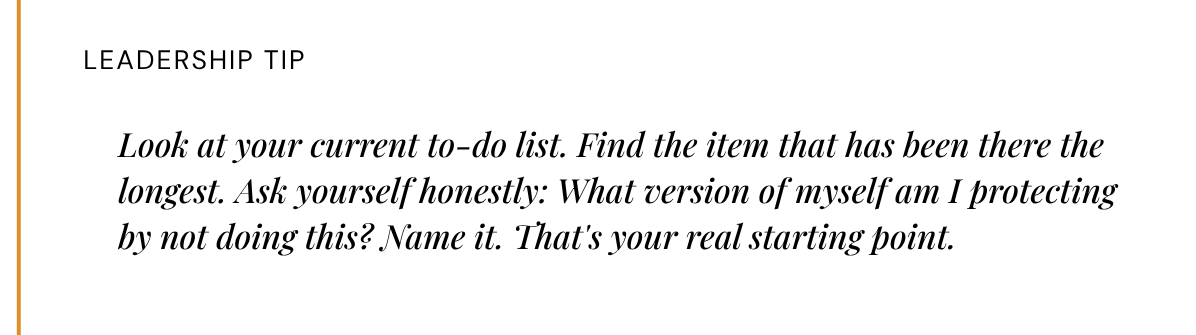
Procrastination is almost never about the task. It's about identity.
When you delay a difficult conversation, avoid a decision you know you need to make, or find yourself inexplicably busy with low-stakes work — something deeper is usually happening. You are protecting a version of yourself that might be threatened by the outcome.
The high-performer who keeps postponing a hard performance conversation with a direct report isn't being avoidant. They're protecting their identity as someone who is liked, fair, and easy to work with. The leader who delays a strategic decision they've already thought through isn't being indecisive. They may be protecting their reputation for always being right.
In both cases, the delay isn't weakness. It's a signal. And the signal is this: your confidence in this area is still tied to the outcome, not to your integrity.
When Confidence Is Anchored to Results
Performance-based confidence is outcome-dependent. It feels strong when things are going well and fragile when they're not. Because of this, leaders who rely on it unconsciously avoid situations where the outcome is uncertain — which, in leadership, is most of the important ones.
This is the hidden cost of performance confidence: it causes you to manage risk in ways that look responsible but are actually self-protective. You delay the conversation because you can't control how the other person will respond. You avoid the decision because you can't guarantee it will work. You stay busy with things you're good at because competence feels safer than uncertainty.
Over time, this pattern erodes something essential. The people around you begin to sense — even if they can't name it — that you are optimizing for appearance rather than truth. Trust quietly thins.
When Confidence Is Anchored to Integrity
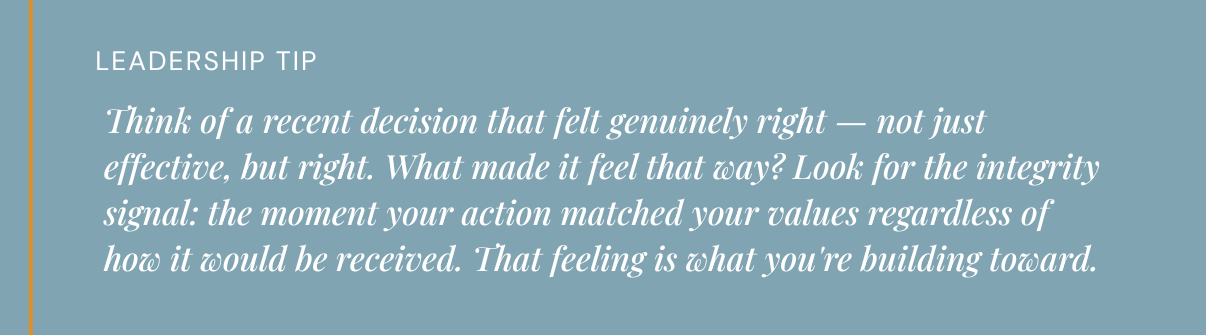
Grounded confidence works differently. It doesn't depend on the outcome being good — it depends on the decision being right. Leaders who have built this kind of confidence can sit with uncertainty without rushing to resolve it.
They can say "I don't know yet" without feeling diminished. They can have the hard conversation, make the unpopular call, or admit a mistake — and experience none of these as threats to who they are.
Because their sense of self isn't riding on the result. It's anchored to the process: did I act in alignment with what I believe.
This is what makes grounded confidence self-sustaining. Every time you act with integrity — especially when it's uncomfortable, especially when no one is watching — you make a deposit. The account grows independent of external results. And when outcomes are disappointing, as they sometimes will be, the foundation holds.
Reclaiming the Postponed Decision
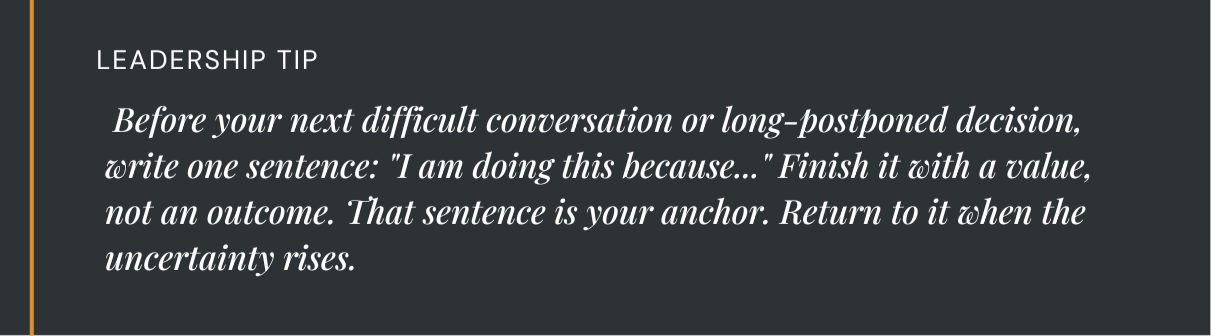
If you've been carrying a decision or conversation longer than you'd like, the path forward isn't to push harder or schedule it more firmly. It's to separate the outcome from your identity.
Ask: If I knew this conversation would go badly — if I knew the decision would be criticized — would I still believe it was the right thing to do? If the answer is yes, your integrity already knows what to do. The procrastination is performance confidence asking for a guarantee that grounded confidence doesn't need.
The delay isn't the problem. It's pointing you toward where the real work is.